
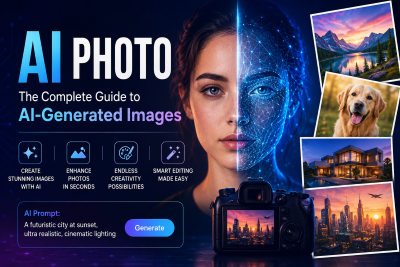
Artificial intelligence has transformed the way people create and edit images. From generating realistic portraits to enhancing old photographs, AI photo technology has become one of the most exciting innovations in digital creativity. Whether you are a content creator, business owner, marketer, student, or casual user, AI-powered photo tools make professional-quality image creation accessible to everyone.
What Is an AI Photo?
An AI photo is an image that is created, enhanced, or edited using artificial intelligence. Instead of manually drawing or editing every detail, users simply provide a text prompt or upload an existing image, and AI generates or modifies the photo based on the instructions.
Modern AI image generators use advanced machine learning models trained on millions of images. These models understand objects, lighting, colors, textures, and artistic styles to produce highly realistic or creative visuals.
For example, you can type:
- “A sunset over snow-covered mountains”
- “A futuristic city at night”
- “A professional business portrait”
Within seconds, AI creates an image matching your description.
How Does AI Photo Technology Work?
AI photo generators rely on deep learning models that analyze vast image datasets to understand patterns, shapes, colors, and visual relationships.
The typical process includes:
- The user enters a text prompt or uploads a photo.
- The AI analyzes the request.
- It predicts how the final image should appear.
- The system generates the image pixel by pixel.
- Users can refine, regenerate, or edit the output.
Some AI tools also allow users to remove backgrounds, replace objects, improve image quality, or apply artistic styles automatically.
Benefits of AI Photos
AI photo technology offers several advantages for both personal and professional users.
Saves Time
Creating digital artwork or editing images manually can take hours. AI produces results within seconds or minutes.
Easy to Use
Most AI photo platforms require no graphic design experience. Users simply enter text prompts or upload images.
Cost-Effective
Businesses and individuals can create marketing visuals without hiring professional photographers or designers for every project.
Endless Creativity
AI can generate unique concepts that may be difficult or impossible to capture with traditional photography.
Improves Existing Photos
AI tools can:
- Sharpen blurry images
- Remove unwanted objects
- Restore damaged photographs
- Colorize black-and-white images
- Increase image resolution
Popular Uses of AI Photos
AI-generated images are becoming increasingly common across industries.
Social Media Content
Creators use AI photos to design eye-catching posts, profile pictures, thumbnails, and promotional graphics.
Marketing and Advertising
Businesses create product mockups, banners, advertisements, and campaign visuals more efficiently.
Blogging
Bloggers use AI-generated feature images, illustrations, and custom graphics to enhance articles.
E-commerce
Online stores generate lifestyle product images, backgrounds, and promotional content.
Education
Teachers and students create visual presentations, diagrams, and educational illustrations.
Entertainment
Game developers, writers, and filmmakers use AI to create concept art and character designs.
Types of AI Photo Tools
Different AI tools specialize in various image tasks.
AI Image Generators
These create completely new images from written prompts.
Examples include generating:
- Landscapes
- Animals
- Architecture
- Fantasy scenes
- Portraits
AI Photo Editors
These improve existing images by:
- Removing blemishes
- Changing backgrounds
- Adjusting lighting
- Enhancing colors
AI Face Generators
These generate realistic human faces that do not belong to real people, making them useful for design, gaming, and illustration projects.
AI Restoration Tools
These repair old or damaged photos by filling missing details and improving image quality.
Best Practices for Creating Better AI Photos
The quality of an AI-generated image depends largely on your prompt.
Consider these tips:
Be Specific
Instead of writing:
“A dog”
Write:
“A golden retriever running across a green meadow during sunrise with soft cinematic lighting.”
Mention Style
Include styles such as:
- Realistic
- Watercolor
- Oil painting
- Cartoon
- Anime
- Digital art
- Minimalist
Describe Lighting
Examples include:
- Golden hour
- Studio lighting
- Natural daylight
- Dramatic shadows
- Neon lighting
Include Camera Details
For realistic images, specify:
- 4K resolution
- DSLR photography
- Portrait lens
- Wide-angle shot
- Macro photography
Limitations of AI Photos
Although AI image generation has advanced rapidly, it still has certain limitations.
Image Accuracy
AI sometimes produces unrealistic hands, faces, text, or complex objects.
Copyright Concerns
Users should carefully review the licensing terms of AI-generated images, especially for commercial use.
Ethical Issues
AI-generated photos can be misused to create misleading or deceptive content. Responsible use is essential.
Prompt Dependency
Poor prompts often produce unsatisfactory results. Better descriptions usually lead to better images.
AI Photo Trends in 2026
AI image technology continues to evolve with exciting new capabilities.
Current trends include:
- Ultra-realistic image generation
- AI-powered virtual fashion photography
- Automatic background replacement
- AI product photography for online stores
- Personalized avatars
- Image-to-image transformation
- 3D AI artwork
- Video generation from still images
- Real-time photo editing using AI
These innovations are making creative workflows faster and more accessible across industries.
Tips for Using AI Photos Responsibly
To make the most of AI-generated images:
- Always verify image authenticity when accuracy matters.
- Respect copyright and licensing requirements.
- Avoid creating misleading or harmful content.
- Label AI-generated visuals when appropriate.
- Use AI as a creative assistant rather than a replacement for originality.
Responsible use helps build trust while encouraging innovation.
The Future of AI Photography
The future of AI photography looks promising. As models become more accurate and easier to use, we can expect even more realistic image generation, smarter editing tools, and seamless integration into everyday applications.
Businesses will increasingly rely on AI for marketing visuals, product photography, and branding. Artists and designers will continue using AI to accelerate ideation while adding their own creative touch. Consumers will enjoy faster, more personalized photo editing experiences on smartphones and computers.
Rather than replacing human creativity, AI is likely to become a powerful partner that helps people turn ideas into stunning visuals with less effort.
Conclusion
AI photo technology has changed how images are created, edited, and shared. From generating artwork from text prompts to restoring old family photographs, AI offers powerful capabilities that save time and unlock new creative possibilities.
While the technology has some limitations and ethical considerations, its benefits for individuals, businesses, educators, and creators are undeniable. By learning how to write effective prompts and using AI responsibly, anyone can produce impressive visuals that enhance personal projects or professional work.
As AI continues to evolve, it will play an even greater role in photography, design, marketing, and digital content creation, making high-quality image production faster, smarter, and more accessible than ever before.
AI Tools for Digital Marketing: A Complete Guide for Businesses in 2026